

Valzhyna Mort
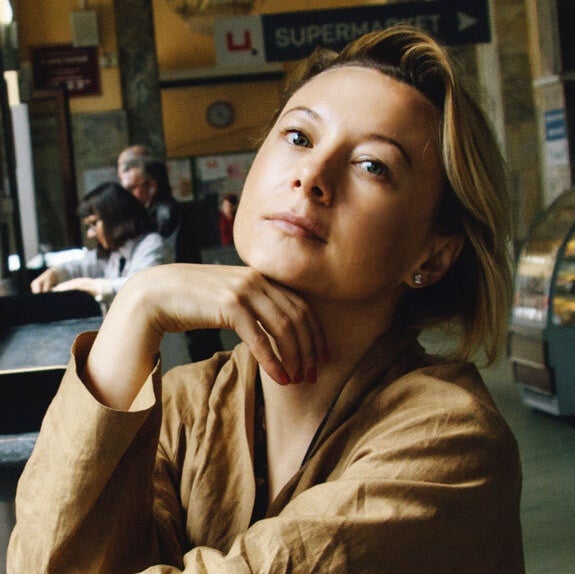
Valzhyna Mort is a poet and translator born in Minsk, Belarus, and she writes in English and Belarusian. She is the author of three poetry collections, Factory of Tears (Copper Canyon Press 2008), Collected Body (Copper Canyon Press 2011) and, mostly recently, Music for the Dead and Resurrected (FSG, 2020), named one of the best poetry book of 2020 by The New York Times and The NPR, and the winner of the 2020 International Griffin Poetry Prize and the 2022 UNT Rilke Prize. Mort is a recipient of fellowships from the Guggenheim Foundation, the American Academy in Rome, the Lannan Foundation, and the Amy Clampitt Foundation.
Her work has been honored with the Bess Hokin Prize from Poetry. She teaches at Cornell University.
Ars Poetica
–Valzhyna Mort
Not books, but
a street opened my mouth like a doctor’s spatula.
One by one, streets introduced themselves
with the names of national
murderers.
In the State Archives, covers
hardened like scabs
over the ledgers.
Inside a tiny apartment
I built myself
into a separate room,
peopled it
with the Calibans
of plans for the future.
Future that runs on the schedule of public buses,
from the zoo to the circus, what future;
what is your alibi for these ledgers, these streets, this apartment, this future?
In the purse which held—
through seven wars—
the birth certificates
of the dead, my grandmother
hid—from me—
chocolates. The purse opened like a screaming mouth.
Its two shiny buckles watched me
through doors, through walls, through jazz.
Who has taught you to be a frightening face, purse?
I kiss your buckles, I swear myself your subject.
August. Apples. I have nobody.
August. For me, a ripe apple is a little brother.
For me, a four-legged table is a pet.
In the temple of Supermarket
I stand
like a candle
in the line to the priestesses who preserve
the knowledge of sausage prices, the virginity
of milk cartons. My future, small
change after buying necessities.
Future that runs on the schedule of public buses,
streets introduced themselves with the names
of national murderers. I build myself
into a separate room, where memory—
the illegal migrant in time—cleans up
after imagination.
In a room where memory strips the beds—
linens that hardened like scabs
on the mattresses—I kiss
little apples—my brothers—I kiss the buckles
that watch us through walls, through years, through jazz;
chocolates from a purse that held—through seven wars—
birth certificates of the dead!
Hold me, brother-apple.
Published in Poetry (November 2019).
Links
- Valzhyna Mort’s website.
- “‘I Trust Nothing But Music.’ Valzhyna Mort on the Patient Listening of Writing Poetry,” in conversation with Michael Prior. Literary Hub. 13 April 2022.
- “The PEN Ten: An Interview with Valzhyna Mort,” by Polina Sadovskaya. PEN America. 5 November 2020.
- “‘I Was Drafted Into Music,’ Says Poet Valzhyna Mort,” by Noel King. NPR. 9 November 2020.
Media
2025-2026 Readings & Talks Series | April 7, 2026
Video link: https://vimeo.com/1184418980?fl=tl&fe=ec
Reading | January 25, 2022
Video link: https://vimeo.com/675505282
Video link: https://open.spotify.com/episode/6iTploqQowUT9UwDc0aIdX?si=967YbM8BSgyx7y6kECwAtA