

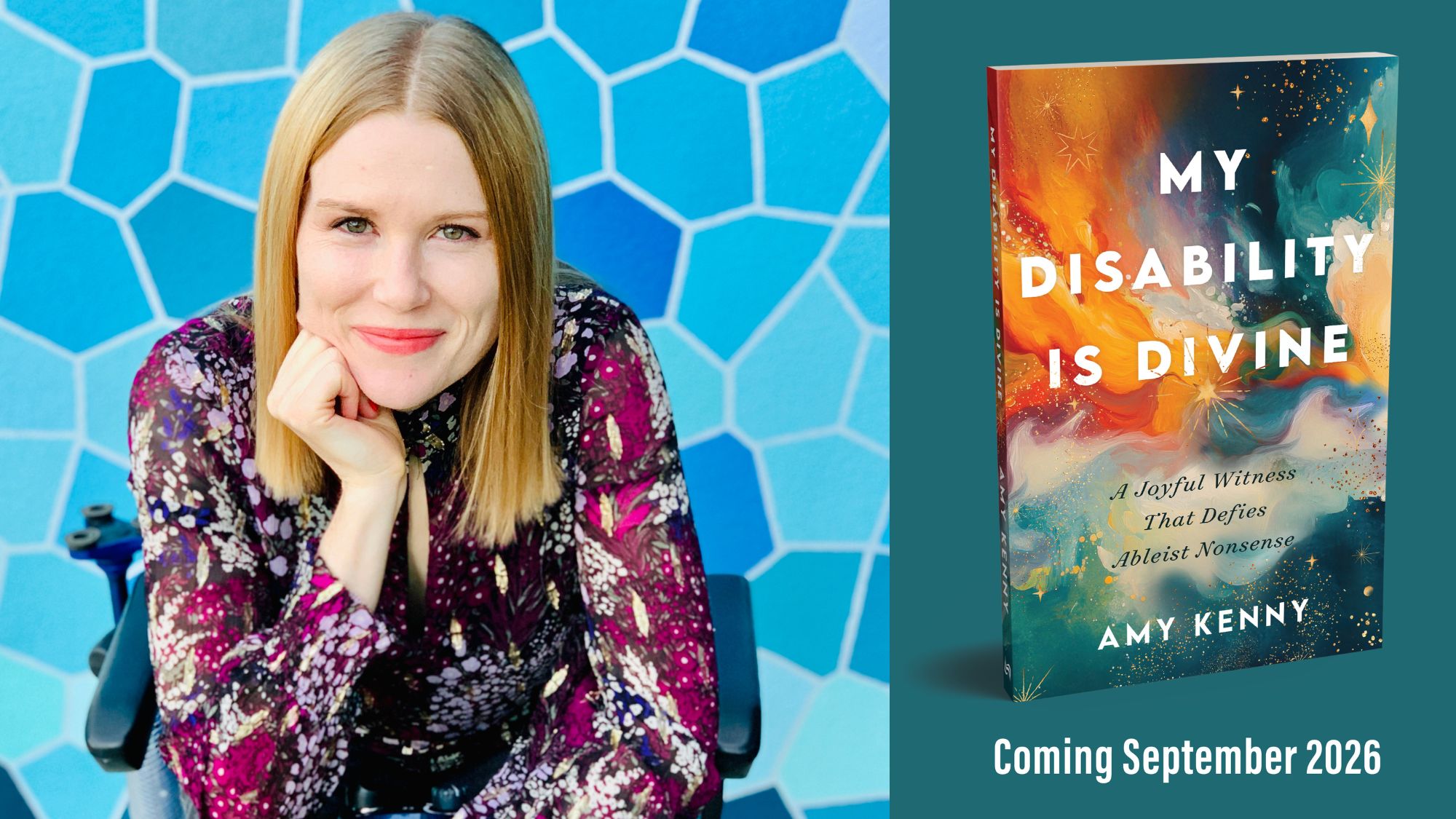
Book Launch for Amy Kenny’s My Disability Is Divine
Posted in Announcements
October 27, 2026 at 7:00PM ET
Location: Copley Formal Lounge
Join us for the launch of Dr. Amy Kenny’s latest book, My Disability Is Divine: A Joyful Witness That Defies Ableist Nonsense. Moderated by author Lisa Sharon Harper.
Accommodation requests related to a disability should be made by October 20th to Patricia Guzman, 202-687-6294, pg654@georgetown.edu. A good faith effort will be made to fulfill requests made after October 20th.
Excerpt from My Body Is Not a Prayer Request by Amy Kenny
I am certainly not the first person to think of God as disabled. Nancy Eiesland, who pioneered disability theology, imagined God in a sip-and-puff wheelchair. After a friend declared that her disability would be removed in heaven, Eiesland was horrified because she felt that would erase a part of who she was and how she understood God. To nondisabled people, this is particularly difficult to understand because of the hypothesis that disability is always bad or a result of the fall, something to be redeemed from in the new creation. To imagine God as disabled seems to diminish God’s power or presence. “God can’t be disabled,” they inform me. “That’s insulting to the heart of the Creator of the universe,” another retorts. What’s insulting to God is when we don’t consider disabled people image-bearers. Or when we can only imagine paradise by erasing one-quarter of humanity. Or when we don’t feed the least of these when it is well within our power to do so.
I am not interested in adding to the will-we-or-won’t-we-be-disabled-in-heaven conversation. On some level, it doesn’t matter if our heavenly bodies will be disabled or not. No one can know that. It is out of my control and does nothing to restore the way I am treated now. But at the very least, I would like to be able to go to church without listening to folks impose their unexamined theology on me. Without being bombarded with so many “somedays” and “at leasts” and “you’ll be running/kick- boxing/flying/fixed/whole/human in heaven.” How we think about eschatology influences how we treat people today. We can’t simply put eschatology in another box in our brains. If we believe that disabled people are not whole until they cross an enchanted threshold into the afterlife, that will certainly impact the way we engage with them in the here and now. We talk about God’s kingdom as the now and not yet: the in-between space that we get glimpses of but are not fully a part of yet. Treating disabled people as image-bearers only once we get to the not yet impacts the now. Let disabled people lead in imagining what new creation could be for us. For some, that’s using wheelchairs; for others, it is not. For some, it includes God using ASL. For others, it means seeing. Who’s to say it will be the same for all of us? The disability community is a diverse group of various physicalities, mentalities, and beliefs. Learn from us when we tell you how we imagine restoration. Let our imaginations for restoration light the way.
Continue reading from My Body Is Not a Prayer Request at Earth & Altar.